Showing posts with label detective. Show all posts

Honululu Heat, by Rosemary and Larry Mild


9780990547235-Cover FINAL.indd
Honolulu Heat, Between the Mountains and the Great Sea
By Rosemary and Larry Mild
(ISBN 978-0-9905472-3-5, Trade Paper and e-Book, 298 pages, $14.95)
Find out more on Amazon
Honolulu Heat, Between the Mountains and the Great Sea—the long-awaited sequel to Cry Ohana—brings back the same Hawaii families that readers so warmly embraced. They confront fierce torments, take on exotic challenges, and find new loves.
Leilani and Alex Wong anguish over son Noah, an idealistic teenager who teeters on both sides of the law. He meets Nina Portfia, his dream girl, and they unwittingly share horrific secrets. Facing a murder charge, Noah flees and finds himself immersed in a bloody feud between a Chinatown protection racketeer and a crimeland don who, ironically, is Nina’s father.
Violence targets innocent real estate agents, a Porsche Boxster Spyder, a stolen locket, a petty thief, and an odd pair on a freighter to Southeast Asia. Two mob leaders and the police are pursuing Noah. Torn between loyalty and betrayal, only the boy can unlock his own freedom and bring peace to his family—and Honolulu’s Chinatown.
Chapter 1
Wind and Water
MAN AND NATURE coexist in a not-so-delicate balance, each pushing, and more often punishing, the other. Beautiful, brilliant, respectful in one moment. Violent, vengeful, destructive in the next. The forces engage and recede. A victor emerges in the ongoing skirmish and then relinquishes the laurels——so true on the tiny Garden Isle of Kauai in the middle of the Pacific Ocean. The moment is 11:34 a.m. on the eleventh of September 1992, a Friday.
Alex Wong, an accountant in his early thirties, entered a few more numbers on the keyboard in his home office. But he couldn’t focus on his client’s quarterly fiscal report. His usual pragmatic head just wasn’t in it today. The radio lulled him with Hawaiian slack-key guitar melodies. He leaned back in his swivel chair. Ah, the joy of working in T-shirt and shorts. Gazing out the picture window opposite his desk, he drank in nature at her most seductive. The ocean lay peaceful with nary a whitecap in sight. The sun glared brazenly. Malia, in her baby bikini, sat under a striped umbrella next to Noah, a neighbor’s son. With shovels and pails, the two-year-olds wallowed joyously in the glistening sand. Leilani, in a broad sun hat, sat in a beach chair, dividing her watchful eye between the toddlers and the half-finished seascape on her canvas. The oils were drying quickly in the late-morning heat.
Alex breathed deeply. It doesn’t get any better than this.
At 11:40 a.m., the guitar music stopped in mid-chord. A female voice announced: ‘‘This is a hurricane alert from the National Weather Service. Hurricane Iniki is currently 160 miles south and
80 miles east of Honolulu with winds up to 135 miles per hour. On its present northwesterly track, it is now likely that the main force of the storm will miss the island of Oahu and the islands of Kauai and Niihau. However, the storm’s path is unpredictable. You are advised to secure whatever you can outdoors, then stay indoors, away from outside walls, and particularly, away from windows and glass doors. The storm center is moving at 100 miles per hour. Its track is constantly shifting and could swing north at any time—–onto a collision course with Kauai. Be aware, this Category Four storm is still gathering strength. Stay tuned for further updates.’’
Alex stopped listening. He shut down the computer and placed the monitor face-down on the floor. Sliding bare feet into his size-thirteen sneakers, he hurried out of the house, striding fast to the beach.
Halting squarely in front of his wife, he announced: ‘‘Lani! We need to get the children inside. Now! I just heard on the radio that Hurricane Iniki may be headed our way. We need to get everything inside or else tied down.’’
Leilani, a tawny-skinned Hawaiian with lush dark hair, didn’t even look up. ‘‘Not to worry, Alex.’’ She applied a brush stroke of cobalt green. ‘‘Right after breakfast the TV said the storm was going to pass between Molokai and Oahu and we might just see a little rain.’’
‘‘All that’s changed now,’’ Alex said. ‘‘The hurricane’s eye is moving fast. It could be only a matter of hours before it hits here.’’ ‘‘Alex, the sky is clear blue. Look! Oh, maybe a few more
clouds over that way. So what? I have to finish this. I’m entering it in a juried show next week.’’
‘‘Lani, why are you being so stubborn? Can’t we at least take Noah home?’’
‘‘There’s nobody home. I told Ilima I’d watch him for the day. They went to a house-warming party up in Princeville.’’ She dabbed a bit of silver-gray over a whitecap.
A rare wave of anger crossed Alex’s unshaven face. ‘‘Damn it, Lani, your painting can wait.’’
Scooping up the toddlers, one in each arm, he carried them squirming into the house. He set them down on Malia’s throw rug on the mauka, mountain, side of her bedroom and drew the Hello Kitty drapes shut. Dragging her twin-size mattress onto the floor, he hefted the two children onto it. They gave him a puzzled look, then decided they must be playing a game, and bounced up and down on the soft mattress.
Leilani was about to mix fresh colors, but paused to reflect. It’s not like Alex to be so short-tempered. As if in response, the incoming clouds began to smother the beach with darkness, night descending in midday. She felt a sudden chill. Sharp gusts whipped up the sand, stinging her ample bare thighs. She gathered up her painting paraphernalia and hurried into the house.
When she appeared in the bedroom doorway, Alex looked up, his face grim. ‘‘It’s about time. Give me a hand with the dresser.’’ He stuck a large folded soji screen in front of the window, and the two of them pushed the dresser in front to hold the screen tight against the drapes. Lani gently laid Malia’s matching Hello Kitty comforter over the children; they had already tired of the jumping game and fallen asleep.
During the next hour, Leilani and Alex silently set to work. They crisscrossed masking tape on all the windows; filled empty milk jugs with water; stacked towels and blankets; brought out flashlights plus candles; and laid everything on the floor along one wall of Malia’s room. It was the safest room in the house, with only one window on an outside wall and that was now covered.
Out on the lanai, the steel sofa glider was too heavy to move. They flopped down on it to rest, both of them breathing hard, as much from tension as the physical effort of rushing around to secure things.
Leilani grabbed her husband’s upper arm. ‘‘Look how fast the clouds are moving. They’re coming straight at us.’’
They left the sliding door behind them open to hear the radio——just in time for a new report. ‘‘We interrupt this program… Attention! This is the latest update on Hurricane Iniki. The hurricane’s eye is headed directly toward the south shore of the island of Kauai at 120 miles per hour. Winds have increased to 145 miles per hour with pulsing gusts to 175.’’
The time was 12:42 p.m. Leilani shuddered. ‘‘The humidity is so heavy you could choke on it.’’
Alex eyed the two coconut palms out back and the Cook Island pine at the side of the house. ‘‘There isn’t a leaf or frond stirring out there, and it’s so darn quiet. Not good, eerie even. The calm before the storm.’’
The words barely out of his mouth, a furious gust bowed the two palms inland in deep deference to Laamaomao, the Hawaiian god of the winds. At 12:55 the humidity yielded to a brief drizzle, then a drenching downpour, sending the couple indoors. First checking on the children, who were still asleep, they watched the storm from the center of the living room. Alex drew a protective arm around his wife’s waist. The rain angled at their home from the south. Sand particles peppered the sliding glass doors with a plinking, piling up at floor level as though demanding to tunnel into the Wongs’ domain.
Alex dared not utter his one optimistic thought, as though saying it aloud might jinx them. They had chosen this sturdy little house soon after their wedding four years ago. The outer walls were cement block covered in stucco; the roof was solidly covered in blue ceramic tiles. Yeah, we just might weather this storm, he thought. Or not.
The wind roared and screeched and bellowed. They heard unfamiliar objects strike the house in a clatter of thuds, clinks, and clanks. Although sunset wasn’t due for almost six hours, darkness followed the storm’s intensity, enveloping them. They retreated to Malia’s bedroom. The toddlers slept on, indifferent. Holding hands, the parents leaned against each other as they sat on the box spring of Malia’s bed. Leilani had spread two blankets across the box springs to make the bed more comfortable.
The picture window in the office gave up first. They heard it implode. Flying shards resounded against the common wall between Malia’s room and the office. Plasterboard was no match for
the angry wind. The wall bowed ever so slightly, then a small crack appeared. Like a malicious living thing, the crack spread vertically a few inches, threatening, but somehow containing itself.
The bay window in the living room surrendered next, unleashing the cyclonic forces, toppling lamps and ripping Leilani’s framed paintings from their picture hooks. Shelves displaying her hand-built ceramics trembled. Glazed pots in glowing colors, comical dogs, cats, and geckos turned into missiles, hurtled against the remaining walls and windows——until there were no windows and no art works left to be destroyed.
Alex and Leilani knew from the clatter in the kitchen, beyond the opposite wall, that the winds had attacked from yet another direction——sounds of cabinet doors slamming open against their frames. Thumps and thuds as the wind became a giant sweeping hand across the countertops, littering the floor.
They heard an elongated groan ending in a loud thump outside. Leilani screamed as she sensed it was the massive ironwood tree next to their driveway crashing down——hoping it wasn’t crunching her new Toyota Corolla. It was 2:05 p.m. The blunt force of the storm was upon them.
Another ten minutes passed and the electricity failed. Alex lit one of the candles and heated its opposite end with the match, so it would stick to the bottom of a water glass. This he set atop the dresser and sank back down on the bed next to his wife. He took her hand in his and squeezed it whenever he sensed her quivering responses to what they were hearing. An ear-splitting crash resounded at the opposite end of the house, followed by the clatter of loosened roof tiles falling onto the cement driveway for several seconds afterward. She began to shake. Even the candlelight shivered, creating eerie dancing shadows in the room.
‘‘The avocado tree must have fallen on the master bedroom side of the house,’’ he calmly offered, so as not to upset Leilani.
‘‘Mommy, mommy!’’ The wailing, frantic cry jolted them. Noah thrashed about on the mattress in the middle of the floor. ‘‘I want my mommy!’’ he screamed.
‘‘Maybe the crashing tree woke him,’’ said Leilani.
Alex picked Noah up, cradling him. ‘‘You’ll see Mommy soon,’’ he said in a soothing voice. But the little boy refused to be comforted. His chubby body heaved and struggled as he sobbed. Alex steadfastly kept rocking, until Noah, exhausted from his own protests, nuzzled silently against Alex’s chest.
Leilani’s watch said 3:50 when Malia awoke with a whine and toddled over to her mother, arms raised, to be picked up. Leilani pulled her in and held her close, not able to speak for fear her own anxiety would be contagious and frighten her baby girl.
Minutes later the ruckus and howling winds outside the house ceased, and all they could hear was the persistent beat of the rain. Then, surprisingly, even that disappeared. It was as though nature had flipped a switch and turned the storm off.
Is the storm over or are we merely stalled in the hurricane’s eye? Alex wondered. He had to venture a peek outside and see what was going on. He set Noah down on the mattress and handed him a stuffed teddy bear; the boy seemed content enough, at least for the moment. Selecting the one Maglite from the group of flashlights, he looked across at his wife.
‘‘All quiet. It must be the eye of the storm.’’ He cautiously opened the bedroom door and peeked out into the living room, strewn with sand and debris. He stepped out, closing the door behind him.
‘‘Be careful and don’t go too far from us,’’ Leilani called out to him.
Switching on the Maglite, Alex stepped into what had been their lovingly arranged and organized living room. The irony of it. Weak sunshine illuminated what now looked like a city dump, covered with wet sand and puddles of water. Pieces of Leilani’s artwork amassed and embedded against the inland wall; the two upholstered wing chairs on their sides; the TV set smashed on its belly; end tables overturned with legs broken. Huge shards of bay window glass stuck or lay everywhere.
Glancing through the void where the sliding doors should have been, Alex saw sunlight overhead, but black clouds still blanketed the sky elsewhere. The lanai no longer had its wood-slatted roof. The air was soundless with the exception of water dripping everywhere. They had certainly entered the eye of the storm. Feeling his way to the kitchen, his sneakers immediately met up with the storm’s clutter. He pushed all the cabinet doors shut, but not before noting that boxes and cans of food inside somehow had stayed in place; and luckily, their wooden table had remained upright. From the kitchen he crossed the living room to inspect the master bedroom. Their tall, full avocado tree had indeed fallen onto the roof of that room, denting and slightly caving the roof in, but not destroying it.
The hesitant patch of sunlight now surrendered to a shroud of blackness like a moonless nightfall. A distant whine pierced the heavy air once more and grew louder. Palm trees hunched in defeat, their fronds pointing stiffly in unison. Smaller objects were flying again.
Leilani, making sure the toddlers were still asleep, anxiously opened the bedroom door and stepped out. Her brain stubbornly refused to accept the destruction in the living room. A returning Alex wrapped his arm around her shoulders in empty reassurance. He shuffled Leilani back into Malia’s room, shutting the door behind them. Just as they slumped down beside each other on the box spring, her dark eyes filled with tears. He gave her an extra squeeze.
Alex somehow knew this terrible storm wasn’t finished.
Just then, Noah rolled onto his side and moaned. Husband and wife looked at each other, sharing the same feeling of alarm. Where are Noah’s parents? Are they safe? Did the hurricane hit Princeville?
Alex knew it might be days before the electricity was restored. He stood and walked to check if the door was securely closed. When he turned around Leilani was standing and crying.
‘‘Why now?’’ she sobbed, her hands in motion. ‘‘Why, when everything was going our way? Must we always live in fear?
What have we done to anger the gods so much?’’
Alex acknowledged that there were no rational replies to such questions——and he certainly didn’t have to answer to the Hawaiian gods. His wife’s repeated reference to these gods was a cultural, traditional obsession stemming from her grandmother, Tutu Eme, and not religious in nature. But he felt obligated to give comfort anyway. He wrapped his arms around her and drew her close once more. Alex Wong, the son of a Japanese mother and Chinese father, was neither superstitious nor religious.
The storm howled and battered away, but there was yet another noise, a repeated and distinctive one.
‘‘Listen, Alex! Someone’s pounding on our front door,’’ said Leilani, slipping out of his embrace and putting her ear to the wall.
‘‘I’ll take a look. Push the door shut after me.’’ He pulled the door ajar and bent almost backward to stay upright against the whirling wind. He labored through the living room, kicking away obstacles that had once made their house a home. He was able to hear an urgent voice through the missing stained-glass window that Leilani had created near the top of their door.
‘‘Please, Alex. Let us in, for God’s sake. We’ve lost our whole roof and need shelter. We’re soaking wet.’’
Alex recognized his neighbor from across the road. ‘‘Just a minute, Jesse, while I get this open.’’ It took all his strength pulling and Jesse pushing to get the front door open. Ellie Duran slipped through first, carrying their swaddled four-month-old infant. As soon as Jesse followed her inside, they allowed the door to slam shut again.
‘‘Wait! Be careful! The power’s out,’’ Alex warned. He switched on his Maglite, concentrating the beam on the debriscovered floor toward Malia’s room. Hunching forward into the wind, he followed them and called to Leilani, ‘‘It’s me and the Durans. They’re going to stay with us.’’
Once everyone was inside, Leilani handed them towels and took the baby from Ellie so the family could dry off. Frightened by the darkness, too confused to babble, Malia and Noah sat wideeyed on the mattress and watched the grownups.
‘‘You folks have one of the only houses in sight with a roof overhead,’’ Jesse said. His voice trembled. ‘‘What a disaster outside.’’ He described the impassable roads strewn with downed trees, abandoned cars, and beach sand piled up in little dunes. ‘‘The Kaleos’ house next door was hit bad, but looks like it survived——sort of.’’
‘‘What about our cars?’’ asked Leilani. ‘‘Did you see what happened?’’
‘‘Sorry Lani, your Corolla is a total loss, but the Cherokee appears to be intact.’’
Alex braved a foray across the living room to the master bedroom to bring back dry clothes——pants, T-shirts, and underwear——for the Durans, with hand towels to turn into diapers.
The howling slowly dissipated. The drenching, driving rains eased, then ceased altogether. It was 7:30 p.m. The storm had finally passed over them. Ellie stayed with the children while the others ventured out to inspect the rest of the house. In the kitchen, Alex worked in the beam of his Maglite.
He found a broom and dustpan and swept up the smashed glass coffeepot and other debris. Next, he lifted the dented toaster-oven and small microwave oven back up to the counter.
The master bedroom had a hole in that corner of the roof where the tree had fallen, but the tree still covered much of the opening. In fact, their king-sized mattress had stayed dry, and much of the bedroom furniture was still intact. But there was no guarantee that the roof wouldn’t cave in entirely from the tree’s sheer weight. Nothing in the living room or dining room appeared salvageable.
‘‘I’ve got a small portable gasoline generator,’’ said Jesse, ‘‘and some heavy-duty tarps in what’s left of my tool shed. Maybe we can at least salvage the food in both our fridges and have a little electricity left over for some light. The tarps can cover some of the holes here. Problem is, they’re probably under a mess of debris right now. Are you willing to tackle this with me?’’
‘‘Let’s go!’’ said Alex.’’ He actually felt buoyed up with the relief of having something useful to do.
The two men had to slog through muddy ponds and climb over tree limbs and house parts just to get to Jesse’s property. There was no sign of the Durans’ roof. The men skirted the three remaining house walls still standing. They found the roof of the tool shed wedged between two trees, with the shed’s corrugated steel walls collapsed inward. Using a pole as a lever, they managed to slide the steel walls out of the way. They found the tarps first and searched for the portable generator next. At last they exposed its red metal exterior.
The generator was too heavy to lift. Even in its carriage it couldn’t be moved; the carriage wheels were too small to be of any use without bogging down in the mud. Jesse made a sled out of a flat piece of steel and some heavy cord. With huge effort and a lot of muscle, they slid the generator onto the makeshift sled and got the rig moving. Jesse was able to retrieve an axe and a saw from the tool shed he’d uncovered earlier. They made quick work of a tree branch that barred their way. The two men dragged the sled across the road to the window outside the Wong kitchen.
Jesse removed the gas cap and discovered the tank empty. No surprise. Alex came to the rescue. He kept a siphon in the trunk of his Jeep Cherokee, along with a gas can. When they were ready to start the generator, Leilani tossed the end of an extension cord out the kitchen window. Alex turned the key. The engine choked. He tried the starter cord. After a dozen hopeless pulls, he surrendered the job to stronger Jesse. Five pulls later, the generator engine took hold. Jesse adjusted the choke and throttle until it ran smoothly. Alex plugged in the extension chord and immediately Leilani yelled out, ‘‘The fridge is running. We’ve got lights! Let’s see if we can rustle up some food.’’
The men did a high five, and Jesse said, ‘‘Let’s cover the hole in your master bedroom roof next, pal, then I’ll be ready to call it quits for the night.’’ Hacking away at two large roots, the avocado tree soon slipped away from the roof and fell to the ground.
Using a tree branch, they poled up and draped one of the tarps over a corner of the bedroom roof. Standing on the front window sill, Alex stapled the tarp to a sloping beam and repeated the stapling from the window on the side of the house.
The families huddled up to the kitchen table, children on laps, Ellie nursing the baby. At 9 p.m. they devoured left-over chicken with rice and wilted, warmish salad.
But Leilani was merely keeping up a brave front. She’d already made up her mind. No matter how much repairing and rebuilding they could do to their dear little house, it would never be enough. She wasn’t going to live each day in anguished suspense, fearing another hurricane. She knew that every time high winds or heavy rain assaulted their vulnerable island, she would feel a sense of doom——that maybe next time they wouldn’t be so lucky. She hadn’t graduated with honors from the University of California at Berkeley to spend her life under a cloud of anxiety——from weather they couldn’t control or vengeful gods they couldn’t appease.
She’d wait a few days to break that news to Alex. For sure, they would go back to Oahu. Of course, they’d wait for little Noah’s parents. Leilani’s eyes welled up with fresh tears. He was still whimpering for his mommy.

Chapter reveal: WHITE WITH FISH, RED WITH MURDER, by Harley Mazuk


WhiteFish_RedMurder Final.jpgTitle
: WHITE WITH FISH, RED WITH MURDER
Genre: Mystery
Author: Harley Mazuk
Publisher: Driven Press
Purchase on Amazon
About the Book:
P.I. Frank Swiver accepts an invitation from a wealthy connoisseur to attend a wine tasting on a private rail car. The host, General Lloyd Thursby, entices Frank with an offer of much-needed work, and the other guests with the promise of a pour of a rare California wine, Ravensridge Blackbird Noir.  On board, Frank, accompanied by his secretary and lover Vera Peregrino, finds an old flame, the recently widowed Cicilia O’Callaghan, among the guests.  It turns out that Thursby wants Frank to investigate the murder of his good friend, Rusty O’Callaghan, Cicilia’s late husband.  But all does not go as planned:  General Thursby is murdered before the wine tasting has even begun. Locked into the private carriage and steaming north from San Francisco, the guests proceed to pull some corks and theorize who among them could be the killer. The cops arrest Vera for Thursby’s murder and while she languishes in her cell, Frank’s renewed affair with Cici heats up.  But another murder follows and Frank realizes that his romance with Cici is poisonous.  He’ll have to change his perceptions and find the real killer—or lose both Cici and Vera…and maybe even his life.

EXCERPT:
A few lights were on in the lounge; I could see burgundy wallpaper with dark wood trim. To my right were two dining tables, each with four seats, and on the left an upright piano with a light oak finish. Beyond that, a group of folks sat in the far end of the car. I led Vera partway down, until the man facing us spoke.
“Ah, you must be Frank Swiver,” he said.
“I am, and this is Vera Peregrino.” There were nods and greetings, and the man who had spoken rose. I strode across to shake his hand.
“Lloyd Thursby,” he said. He was an older gent with gray hair and clear, alert blue eyes. He wore a camel hair topcoat draped on his shoulders like a cape, over a dark brown, well-cut suit. He stood a couple of inches taller than me, maybe six foot two, and he carried himself ramrod straight, so he appeared even taller. I had the idea he was fit and powerful for his age. “This is my majordomo,” he gestured at a man standing near the rear corridor of the train car, “Fenwick.” He was younger and three or four inches shorter than Thursby.
Fenwick stepped forward. “I’ll take your bags, sir.”
I gave him my duffel and Vera’s suitcase, and when he reached out his arms to take them, his sleeves slid up, revealing thick, dark hair on the backs of his wrists and hands. He carried the luggage into the corridor, and his wrists stayed down out of his sleeves making his arms appear long and apelike.
General Thursby held out his left hand toward a dame in a chair on my right. “This is Sally DeBains.” She was well dressed and well coiffed, fiftyish, and blond—though I suspected the hair color came out of a bottle.
“How do you do?” she said. She had plenty of ice on her fingers, and I clasped the hand she extended and gave it a light kiss. I thought about biting one of the rings, but she didn’t strike me as a big Three Stooges fan.
“I’m well, thanks,” I replied. “How do you do?” More jewelry drooped around her neck, and she obviously had gained a couple of pounds as she aged. She may have been shaking her maracas a bit lower than she used to, but she had probably been a hot number twenty years ago. For my money, she was still hot enough.
Thursby stepped back toward his chair and extended his right hand. “Over here, allow me to present Marcus Aurelius Wolff, our philosopher, and a fellow collector.”
Wolff was a huge, fat man, whose bulk blocked much of the light from the window behind him. His three-piece charcoal  pinstriped suit oozed polish and quality, and he held a pearl-gray hat in his lap. Although it was cool, and I still had my trench coat on, the fat man was perspiring. He beamed and drew a silk hanky out of his breast pocket, then wiped his bald head.
“An honor, sir, an honor to meet you,” said Wolff.
I assured him the honor was all mine. “A collector of what?” I asked.
“Why wine, Swiver, wine, of course.” Thursby laughed. “That’s what brings our little group together, you know. We taste wine, we savor it, we debate about it.”
“And what do you do, sir?” Wolff asked me.
“I drink it.” I gave him a grin.
Thursby stepped in. “Frank is a writer working on my biography.” Writer was as good as anything. General Thursby had enclosed a hand-written note with his invitation:

Swiver,

I hear you know a little about wine, but that’s not the only reason I’m inviting you to my tasting. I’d like to hire you. I’ll brief you about the job on the train. You can bring another operative if you like. Make it look as if you’re along for the party—I don’t want to tip my hand. Whether you take the case or not, I’ll pay you for your time and you’ll get to taste some good wines.

Thursby

That was all I knew; it wasn’t much, but it was enough to get me there. I hadn’t had a case for weeks, other than the contract work at the hotel, and I needed the money. He didn’t want to tip his hand. I would play along.
“Miss Peregrino is my research assistant,” I said. Vera smiled.
And so we circulated around the room and met the guests, and Vera and I shook hands like a couple of politicians at the Orange County Fair.
And then as the introductions were coming to an end, I saw her, to my left, by the piano. A short black dress, low cut, raven-dark hair, emerald eyes that almost glowed, over robust cheekbones—it was Cicilia Ricci, girl of my dreams.
“And last, this is Cicilia O’Callaghan,” the general went on. “Cicilia—”
“We’ve met.” A chill ran up my spine.
“Hello, Frank. It’s been a while.”
“Fourteen years. You look good, Cicilia.” The widow O’Callaghan, formerly Cicilia Ricci. Her hair was cut a little shorter than when I knew her—wavy on top, parted in the middle, and falling down to her shoulder blades in curls. Her dark eyebrows curved high over her big eyes in graceful roman arches. She’d been seventeen when I met her; she’d be thirty-two now. No longer a budding teenager but a woman in her prime, and more ravishing than ever, if that was possible.
“You look well too, Frank.” Her voice was deep, smoky, seductive. It was Cici’s normal voice.
I shook another Pall Mall out of the pack and fumbled with a box of wooden matches like a nine-year-old trying to light up in the schoolyard. “Having a little trouble, Frank?” Vera noticed. She tilted her head down and to her right, and angled an eye up at me, amused. She relieved me of the matches, struck one and held it out, steadying my hand as I lit up.
C’mon, Swiver, get a grip on yourself. You’re on a case. I clenched and unclenched my fists, and turned away from Cicilia to face the general.

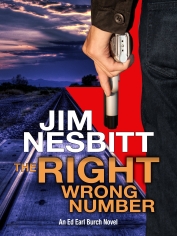
The Right Wrong Number, by Jim Nesbitt


edearl56-300dpi-3125x4167Title
:  THE RIGHT WRONG NUMBER
Genre: Mystery
Author: Jim Nesbitt
Publisher: Spotted Mule Press
About the Book:  
When the phone rings long after midnight, it spells trouble of the lethal kind for Ed Earl Burch. A cashiered homicide detective with bad knees, a wounded liver and an empty bank account, Burch has been hired to protect an old flame after the disappearance of her husband, a high-flying Houston financier who ripped off his clients, including some deeply unsavory gentlemen from New Orleans.
It’s a simple job that goes wrong fast, plunging Burch into a ruthless contest where nothing is as it seems and no one can be trusted. Money and sex— twin temptations served up by the old flame, a rangy strawberry blonde with a violent temper and a terminal knack for larceny and betrayal—tempt Burch to break his own rules. But when his best friend gets murdered by hired muscle in Dallas, Burch blames himself and grimly sets out for vengeance.
Bristling with relentless action, a pulse-racer of a plot, a solid storyline, and a colorful cast of characters, The Right Wrong Number is hard-boiled detective fiction at its finest. With his pitch-perfect voice and keen eye for detail, Jim Nesbitt uses the skills honed over decades of deadline journalism to create an extraordinary story centered on a protagonist like no other: the deeply flawed but wildly compelling Ed Earl Burch. A taut, tense, uncompromising tale of revenge and redemption, The Right Wrong Number is a damned good story exceptionally well-told.

THE RIGHT WRONG NUMBER 
An Ed Earl Burch Novel


ONE 
It wasn’t San Francisco or London, but the fog was thick and flowing — like tufts sucked from a bale of cotton, carrying the muddy tint of a used linen filter. It made him think of trench coats, lamp posts and the low warning moan of a ship’s horn sounding somewhere out on the water. Rolling across the flat fields, it made dark gray ghosts of the trees that huddled along the far fencelines and left cold beads of moisture on his skin and memories of old black-and-white movies in his mind.
But there were no ships in the harbor, no waterside buckets of blood, no Rick or Ilsa. Just lightless farmhouses, barns, open-sided equipment sheds and squat corrugated feed bins for cattle, all cloaked by the fast-moving fog, glimpsed only if the wind parted the curtain of stained white wetness as you rolled by.
And it wasn’t the Left Coast or Britain. It was Texas and the scrubby coastal country north of Houston, beyond the Intercontinental and its roaring planes. Take a left off the farm-market road with the four-digit number. Find the third dirt road on the left, take it for three miles. Splash through the potholes and set your teeth against tires juddering across the washboard track. Hit the T of another dirt road. Look for a faint gravel trail at your 10 o’clock. Rattle over the cattle guard. Close the gate behind you.
Easy to remember. Hard to do with visibility down to zero. Even with the window rolled down and the Beemer’s fog lamps flipped on. Nice car. Leather seats the color of butterscotch taffy. Mahogany inserts flanking the instruments and fronting the glove box. Killer sound system and a cellular phone. Shame to bang this baby along back roads, splashing mud and gravel against its polished flanks of forest green.
Not his car. Not his problem. Fog and time were. He was already a half hour behind schedule when his contact finally drove up with the car, the briefcase of bills and directions to the meet. Fog was adding more minutes to his travel time. He had to double back when he missed one turnoff and that made him slow and leery of missing another.
Not good. Not good. Patient people weren’t on the other end. They never were. But they would wait because he had the money, they had the product and both sides wanted this deal closed tonight. And if they were pissed and wanted to wrangle, he could deal with that; a matte-chrome Smith & Wesson Model 6906 with thirteen rounds of 9 mm hollow point nestled in a shoulder rig underneath his black leather jacket.
Always the chance of a wrangle on a run like this. Rip-offs were a run-of-the-mill business risk, even between long-time associates. But on this deal the probability of gunplay was low. He was just nervous about running late. It wasn’t professional. He thought about using the cellular phone but shook the idea out of his head. Not something a pro would do.
And not something his people would appreciate. They were security-conscious and worked the high-dollar end of the street. No cowboys. Pros only. Running a well-oiled machine. Not that he knew them well. He was strictly a cutout man, a well-paid delivery boy who made it his business to stay ignorant about those who hired him and their business partners.
He wasn’t totally in the dark about his paymasters; no prudent pro ever was. But he kept his curiosity in check and his focus on the amount of money he was paid and the demands of the night’s job.
It was a relaxing way to make a living. A phone rings. A voice on the line gives him the name of a bar or cafe. A man meets him with an envelope and instructions. And he goes where he is told — to deliver money, to pick up a truck or car loaded with product, to put a bullet through the skull of someone he doesn’t know.
Command and control. Just like the Army and those over-the-border ops in Cambodia. Project Vesuvius. Studies and Observations Group. Words both grandiose and bland to cover what he and his comrades did. Slip over the fence, gather the intel, slit a few throats along the way. Set up the Big Death — from the air and on the ground. Operation Menu. Operation Patio. Operation Freedom Deal. Cambodian Incursion. More bland words for killing the enemy in his safest sanctuaries. Parrot’s Beak. The Fishhook. The Dog’s Face.
A sputtering string of electronic beeps startled him. The car phone. He glanced down and saw a red pin light flash to the time of the beeps. He pulled the receiver out of its cradle.
“Talk to me.”
“Where the hell are you?”
“You don’t want me to say.”
“You’re late and that’s making some people nervous.”
“Your man was late and this phone call is making me nervous. It’s not very smart.”
“We decide what’s smart. We pay you to get things done and be on time. How long till you get there?”
“Ten.”
“Get there.”
He snapped the receiver back in place and shook his head. Not good. Not good. Lots of snoopers scanning these cellular circuits. A pro would know this and wouldn’t risk a call unless the other side was making a ruckus. Made him wonder if the players in this game were as big league as he thought they were.
Those thoughts rode with him as he wheeled the Beemer down the dirt road, looking for the T intersection. There it was. He looked for the gravel trail, slowly turning the car to the left and letting the fog lamps cut a slow sweep across the far side of the road. There. At his ten o’clock. Just like he was told. He stayed alert, but his nagging nervousness and doubts started to fade.
The trail led from the gate and crossed the field at a sharp angle. He crept along, easing the car through ruts and washouts. He saw the shrouded form of a tin shed and weaved the car so the lights would pan across its open door. The yellow beams caught the wet metal of an old tractor and two men in dark slacks and windbreakers — one tall, bald and lean, the other short, squat and slick-haired.
He stopped the car, fog lamps still on. He pulled his pistol, letting his gun hand drop to his side and rear as he stepped out, keeping his body behind the car door.
“Wanna cut the lights, guy?”
A purring voice from the short guy, coming from a full, sleek face that made him think of a seal.
“Not really. Let’s keep everything illuminated. Makes me feel safe.”
“You’re among friends, guy. Nobody wants monkeyshines here. We just do the handoff and the call and we can all get the hell out of this fog. You’re late and we’re cold.”
“No arguments from me, my man. But let’s do this by the numbers.”
“Numbers it is, guy.”
He stepped away from the car.
“Money’s in the front seat. Have your buddy do the honors.”
A nod from the talker. His companion walked to the passenger side of the Beemer and leaned in. He heard the latches of the briefcase pop open.
“Looks good to me.”
“Make the call. That okay with you, guy?”
“By all means. Make that call. Tell Mabel to put a pot of coffee on.”
A laugh from the talker. He could see the other guy reach for the cellular phone. Somewhere across town, a phone would ring. Assurances the money was in hand. Somewhere else another phone would ring. Product would change hands. Then the Beemer’s cellular would ring again and the night’s business would be done.
He was alert but relaxed, ready to wait, the screw-ups behind him and the deal running smooth and professional now. He had a clear view of the talker and his companion. He had his gun in hand. He was thinking about a cup of coffee when the baseball bat cracked across the back of his skull.
“Cut those damn lights. Secure the money.”
A nod from the companion. The talker moved toward the third man, the man with the baseball bat, a hulk with the arms and shoulders of a lineman and the on-the-balls-of-the-feet stance of a third baseman. They stood over the slumped body.
“Give me a hand with this sumbitch. He’s heavy. Get that gun, Jack.”
“Got it. Who’d this guy piss off?”
“Nobody you need to know about, guy. Or me. He’s just a poor soul somebody wants whacked.”
“Awful lot of trouble just to whack a guy. What the fuck are we stagin’ this thing for, Louis? Why not just pop him and get it over with?”
“Not your worry, guy. Just muscle him into the driver’s seat and let me dress him up pretty. Bill, did you wipe your prints?”
“Does it matter?”
A glare from Louis. The companion shrugged, pulled a bandana from his back pocket and leaned into the Beemer. When done, he hoisted the briefcase and walked back toward the shed.
Louis kept his eyes locked on the bald man as he walked away, his head swiveling like a table-top fan, his eyes popped with anger. He broke the stare and fussed with the body, pulling the head back, reaching into the mouth, then his pocket, then back into the mouth. Jack watched and shook his head.
“Bill!”
“Yo!”
“Get me that bundle, guy. The jacket and the trench coat. And bring that bag with the stuff in it.”
“Yo.”
Bill hustled to the car. Louis patted him on the shoulder, thanking him in that purring voice, his face soft and placid again. He turned back to the body, peeling off the leather jacket and unfastening the shoulder rig. He fished through the pockets, pulling wallet, keys and a checkbook, leaving loose change. He replaced these items with wallet, keys and a checkbook he pulled from a crumpled brown paper bag. He pulled a ring from the right hand and a fake Rolex from the left wrist, digging a wedding band, a class ring and a real Rolex — an Oyster Perpetual Datejust — from the bag.
The jacket and trench coat came next — a nicely tailored Burberry, pity the waste. Louis started to sweat as he pulled and smoothed the clothes onto the body. He unbuttoned the shirt down to the navel, then reached into the bag and pulled out a squeeze bottle, the kind with the thin nozzle that could poke through the bars of a footballer’s facemask. He squeezed water onto the body’s chest then reached under the dash to pop the hood of the Beemer.
“Jack — hook up those cables, guy.”
“Jesus.”
“I know it’s unpleasant, but just do it for me, guy.”
Louis fired up the Beemer’s engine then waited for Jack to hand him the twin clamps. Clamps to the body’s chest. The smell of burning flesh and electrified ozone.
Again. Again the smell.
And again. Clamps to Jack. Engine off.
“Bill. The acid, guy.”
A glass bottle of sulfuric acid. A small glass tray. Fingers and thumb from one hand in. Then the other hand. He handed the tray to Bill.
“Careful with that, guy. Dump it.”
“Yo.”
Louis turned back to the body. He pursed his lips as he lined up the shoulders, the head and the arms to stage the proper angles of a kill shot.
The head was the difficult part. Without a helping hand to hold it in place, it rolled about and wouldn’t stay upright. Louis pulled the hips forward then shoved the shoulders deep into the folds of the leather seat, pressing them into place. The head was now resting lightly against the butterscotch leather padding of the headrest.
That’s how it would line up. He stood up and pulled a snub-nosed Colt Agent in .38 Special from the paper bag with a gloved hand. He eyed the angle for another second then nodded Jack away.
Louis eased the pistol barrel into a sagging mouth, eyeing the angle one more time. He pulled the trigger, blinking at the pistol’s flash and sharp report. He dropped the gun to the floor.
The bullet had blown off the back of the man’s skull, obliterating the pulpy mark of the baseball bat and spraying a dark stain of brains, blood and bone shards across the light-colored leather seats. The impact canted the body across the console and gearshift, head and shoulder jammed between the seats.
“Jesus, Louis.”
“What?”
“Christamighty, it’s one thing to whack a guy up close like that, another to do all that shit with the battery cables and the acid. But to have to fish out his dentures first? They’d have to pay me double to do that.”
“They are, guy. They are.”
“Whadja have to do it for?”
“They were making his gums sore. He needed a new pair.”
“Like he’ll need ’em where he’s going.”
“You never know. Blow the car, Jack. We gotta get us back on home, guy. Get us on the outside of some gumbo down to Tujague’s.”
“I’m for that. A shame though. This is a nice car.”
“That it is, guy. Blow her just the same. Make it burn pretty.”
“Lotta noise. Lotta flash. Cops’ll be here like flies on a dead fish.”
“Do it quick then, guy. So we can be long gone.”

Chapter reveal: Dying to Tell, by Tj O’Connor


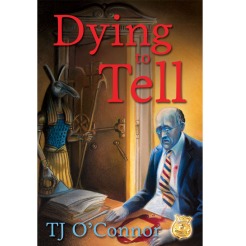
DTT Cover 800 jan 2016 copyTitle:  DYING TO TELL
Genre:  Mystery
Author:  Tj O’Connor
Website:  www.tjoconnor.com
Publisher:  Midnight Ink
Purchase on Amazon
About the Book:
In Dying to Tell, the latest mystery by award-winning novelist Tj O’Connor, Oliver “Tuck” Tucker—dead detective extraordinaire—is back for the case of a lifetime, or, rather, the afterlifetime.  
A former police detective who now solves mysteries from beyond, Tuck doesn’t appreciate just how perilous the past can be till his wife, Angel, is nearly killed and reclusive banker William Mendelson is found dead in a hidden vault.  Tuck knows there’s more to Mendelson’s murder than decades-old skullduggery. As murderers, thieves, and spies descend on small-town Winchester, Tuck joins up with Angel, old detective partners, and a long-dead grandfather still on an army mission from 1942. With the case unfolding around him, Tuck must confront haunting family secrets and the growing distance between his death and Angel’s life.  The outcome could be a killer of its own, but Tuck is set on solving this case. Dead set.  After all, some things never die…
 CHAPTER ONE
Dying is as perilous as secrets and lies. Depending, of course, on
who is keeping the secrets and who is telling the lies. Trust me, I’m
in the secrets and lies business—I’m a homicide cop. Well, I was.
Secrets and lies can lead to big problems—like murder—although
it’s not in the secrets or the lies themselves. It’s that someone always
wants to tell. The urge is like an addict needing a fix. You need to
tell—you cannot help it—you have to tell. Sometimes it’s out of
guilt. Sometimes it’s for revenge. Sometimes it’s just spite. No matter,
in the end, someone is always dying to tell.
And then bad things happen.
An auburn-haired beauty with green eyes—eyes that could hypnotize
vampires—walked down the outdoor Old Town Winchester
mall through a dusting of blowing December snow. She stopped
momentarily to adjust her long wool overcoat over her athletic legs
and curvaceous, bumpy body—a good bumpy. She looked around
the mall, twice back from where she’d come, and turned down the
sidewalk to the annex behind the First Bank and Trust of Frederick
2
County. When she caught sight of me, her smile—one that normally
could charm snakes—looked more like that of a cobra ready to strike.
I ran to catch up.
No, not because I’m obsessed with vampires or snake charmers.
And no, I wasn’t stalking this classy university professor on her way to
some mysterious early morning appointment. She was my wife, but
she was on her way to a mysterious appointment—and I didn’t know
where or why. So, being the former detective I was, I followed her.
“Angel, where you going?”
“To the bank.” She reached the employee entrance door and stopped.
“Why are you following me?”
Silly question. “Because you’re going to the bank at seven in the
morning. It’s closed.”
She checked her watch. “And it’s almost seven thirty.”
“Haven’t you ever heard of banker’s hours? Who do you think is
here this early?”
She rolled her eyes—a signal that my wit or charm had disarmed
her. “I’ll explain later at home.”
“I’ll wait. We can get pancakes.”
“You hate pancakes. What’s wrong with you lately? Are you spying
on me?”
I did hate pancakes, but watching her eat steak and eggs—my
favorite breakfast—was much more painful. “Spying, no. Me?”
“I didn’t think the dead could be so frustrating.”
Oh, did I mention I’m dead? No? I’m Tuck, formerly Detective
Oliver Tucker of the Frederick County Sheriff ’s office. Now I’m just
Tuck to my friends—those living and dead. I was a hotshot homicide
detective before I went investigating noises in my house late
one night. Those noises led someone to put a bullet in my heart.
3
That was nearly two years ago. And it’s taken me that long to come to
terms with it. Sort of. It helped to catch the bastard who shot me and
put an end to his killing spree. And it helps to have my wife, Angel,
and Hercule, my black Lab, around, too. Dead and gone are two totally
different things. I’m dead, but as Angel and Hercule will tell
you—well, maybe not Hercule, he’s a dog—I’m just not gone.
“Angel, listen, I …”
The steel security door at the employee entrance door burst open
and banged against the brick annex wall. A masked gunman—a tall,
strong-looking figure dressed in dark clothes and the traditional bank
robber’s balaclava—ran from the annex, turned, and fired a shot from
a small revolver. He slipped on the sidewalk, freshly adorned with an
inch of snow, and crashed to the ground. He cursed, jumped to his
feet, and locked eyes on Angel.
“Run, Angel. Run!” I yelled.
Too late.
The gunman scrambled the three yards to us and grabbed Angel
by the arm. “Come here!” He spun her around, pulled her to him
like a shield, and faced the annex doorway.
A bank security guard emerged through the door, gun first.
“Freeze! Let her go!”
The gunman fired two shots in rapid succession. One hit the security
guard and the other slammed safely into the wall two feet beside
him. The guard grunted, staggered back, and went down, striking
his head on a stone flower planter beside the entrance.
“Angel, stay calm,” I said. “I’ll get you out of this.”
“Tuck, help me!”
I dove for the gunman and took two vicious swings trying to free
her. Both blows struck him in the face and neither caused him to
4
flinch. I struck again—lashed a kick to his knee, a jab to the rib cage.
Two more body blows.
Nothing.
“Angel, fight. You have to fight. I can’t help.”
Angel was not a timid or slight woman and she erupted like a
wildcat, taking the gunman by surprise. She twisted and fought
against his grip and nearly broke free.
“Dammit, lady, stop!” He jammed the revolved to her cheek. “Or
else.”
“Tuck,” she cried out, “help me! Tuck …”
Rage boiled over and the explosion started inside me everywhere.
A second later, my fingers tingled and my body burned from
the inside. Seconds were all I had. I lunged forward and struck the
gunman in the throat with the heel of my hand. He staggered back,
relaxing his grip around Angel. I struck two more vicious punches
to his face and followed with a kick to his midsection.
“What the f—” He released her and turned in a circle, his eyes
darting around.
I struck two kidney punches and a sharp kick to the inside of one
leg. He umphed and crumpled sideways down onto one knee. I
crushed him with a two-fisted hammer punch to the back of his neck.
“Run, Angel—go!”
She was only four or five strides from the gunman when he lifted
his revolver and took aim.
A gunshot split the air from behind us, searing a lightning bolt
through me on its way to the bank robber. It struck him in the upper
arm and spun him sideways. A second shot followed but missed him
by mere inches. The gunman was stunned but regained his footing—
his injury wasn’t stopping him. He staggered back, lifted his
5
revolver, and pulled off a shot before he ran around the rear of the
bank annex and disappeared.
“Angel?” I spun around. “Are you all right?”
Apparently, she was fine.
A tall, square-jawed, distinguished man in a heavy wool overcoat
stood beside her now. He had one arm around her, speaking slowly to
her—consoling her—and his other arm hung to his side, a black, compact
.45 semiautomatic handgun in his grasp. He looked like a younger
Clooney, but perhaps better looking. I instantly distrusted him.
“I’m fine, Mr. Thorne, really.” Angel slipped from his arm and went
to the security guard lying on the snowy ground beside the annex
door. She moved over him, checked his wounds, and tried to wake
him. “Call an ambulance. He’s been shot and is unconscious.”
Thorne—a man I’d never seen before—pulled a cell phone from
his overcoat pocket. “Right, and the police. Is Conti all right?”
“I’m not sure.” She investigated a small, thin hole over the guard’s
left breast through his blue suit coat. From inside the coat, she pulled
out a paperback book and held it up. “Agatha Christie saved his
life—Murder on the Orient Express. The bullet hit this and didn’t go
through.”
I put a hand on her shoulder to comfort her—or perhaps, to
comfort me. The rage had passed, and with it, the last of my connection
to the physical world. “Are you okay, babe? I …”
“I’m fine. Go see if anyone else is hurt inside.” She caught Thorne
eyeing her. “There may be more employees inside, right?”
“Not at this hour, no. Let’s wait on the police.”
No, I wasn’t waiting.
6
A voice beckoned me into the bank and I followed. It wasn’t a
voice—not really—it was more like someone telegraphing words
into my head: “It isn’t over, kid, follow me.”
The bank annex was dark. The faint morning light was barely
enough to cast more than a dull haze through the lobby windows. I
went through the grand lobby, down a long, dark corridor into the
executive wing. At the end of the corridor were three offices. I stopped
at the suite of William H. Mendelson, Chairman of the Board, First
Bank and Trust of Frederick County—or so said the brass plaque
below the oversized portrait of a silver-haired titan.
The voice from nowhere whispered, “Hurry up, kid. Inside.”
I followed the voice into the pitch-black office and through a
second doorway in the corner of the room—a closet, I thought—
but it was the entrance to a stairwell leading down into more darkness.
Two floors below, in a sub-basement, the stairwell opened to a
wide landing at a heavy steel security gate that looked like a prison
cell door. Beyond the gate was a small anteroom lit by a dim fluorescent
light overhead. The gate was unlocked and open and the anteroom
beyond was empty except for a small metal work table and
two battleship-gray chairs. In the rear of the room was a monstrous,
turn-of-the-century steel vault door—the nineteenth century. To my
surprise, the door was cracked open, and a sliver of eerie light from
inside the vault etched the anteroom wall.
“Inside, Oliver.” The voice was all around me now. “Go inside.”
Oliver? “Who the hell are you?”
“Just go. Quit stalling.”
I turned and found a strange man—a fellow wraith—leaning
against the anteroom wall watching me—not in a casual way, but
trying to appear casual. He had one hand in a pocket of his leather
7
bomber jacket and he tipped a baseball cap that had a big “W” on it
off his brow with the other.
“Trust me, kid. This isn’t the way it looks.” He threw a chin toward
the vault. “Go on in. I’ve done my part. Now it’s your turn.”
Inside I found the Chairman of the First Bank and Trust of Frederick
County.
William H. Mendelson always reminded me of Lionel Barrymore’s
Mr. Potter from It’s a Wonderful Life. He was a starchy, arrogant
old banker who made rare appearances around town. When he
did, he never spoke, didn’t wave, and never, ever smiled. And to
those who knew him, he was never William or Bill—God, never
Billy, either. He was Mr. Mendelson—or more often, the Chairman.
Like he was Frank Sinatra or something, right?
William sat behind a square steel counting table in the middle of
the vault, facing the door. He was dressed in the same blue doublebreasted
suit he must have worn yesterday—from the smell, he’d
been here a while. A dark blood stain ruined his starched white shirt
and expensive silk tie—the result of a small-caliber bullet hole in his
heart. Both hands rested on the tabletop like he was waiting for a
sandwich—or pancakes—and they were stuck to the blackish gooey
remains of his life.
And hanging in the vault air was the heavy, pungent odor of
smoke.
The bomber-jacketed man—strangely familiar—said, “Remember,
kid, it’s not what you think.”
“Hello, William,” I said, looking at the murdered chairman. “I’m
Tuck and I’ll be investigating your murder. Perhaps you can tell
me—what should I think?”